The Scheduling Fix that Saved $500K
PE-Backed Single Family Residential Property Management | VP, Resident Experience & Shared Services
The field scheduling operation was running on a platform that had never been evaluated against what the business truly needed. Schedulers were manually keying every work order into the system because there was no API to transmit or receive orders automatically. There was no routing optimization, which meant technicians were dispatched without any system-level consideration of drive time, mileage or route efficiency.
The consequences showed up in two places:
Scheduler capacity was being consumed by manual data entry that should not have required human effort.
In the field, technicians were driving longer routes than necessary because the system had no ability to optimize
The software contract was not competitively priced relative to what the platform actually delivered and no formal evaluation of the platform had ever been done. The scheduling team had built workarounds for the system's limitations rather than questioning whether the system was the right tool.
The Situation
The Action
A structured technology assessment was run against the current platform and available alternatives. The evaluation criteria were specific and non-negotiable:
Routing optimization to reduce technician drive time and mileage
API capability to eliminate manual work order entry entirely
Total cost of ownership compared to the existing contract
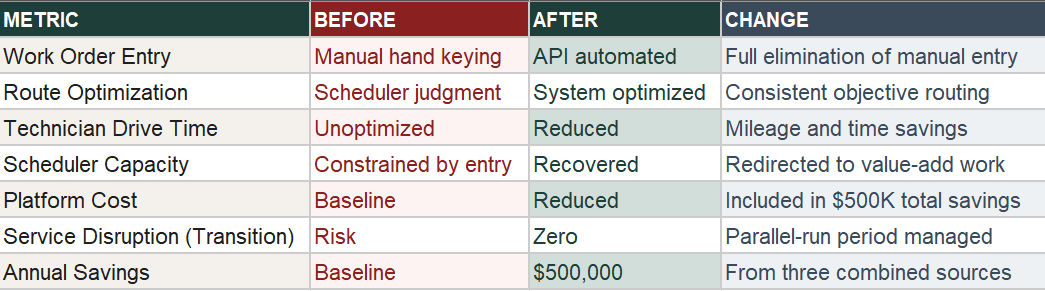
The right replacement platform cleared all three. It optimized routes at the point of scheduling rather than leaving that judgment to individual schedulers. It received and transmitted work orders via API, removing manual entry from the scheduler's workflow completely. The contract cost was lower than the incumbent.
The transition was managed as a project with defined milestones and clear ownership. The scheduling team ran both systems simultaneously during a parallel-run period before the old platform was retired. Process documentation was built during the transition so the new workflow was captured while it was being learned, not reconstructed afterward. The field team experienced no service disruption during the changeover.
The Result
$500,000 in annual savings through three sources:
Reduced software licensing cost
Elimination of the labor cost tied to manual work order entry
Measurable reduction in technician drive time and mileage
Scheduler capacity that had been absorbed by manual entry was recovered and redirected to higher-value work. Technicians spent less time driving and more time working. The routing quality that had previously depended on individual scheduler knowledge and judgment became a consistent system output.