My work speaks for itself.
Fortune 50 GPG Company | Past Ops Leadership Experience
The Situation
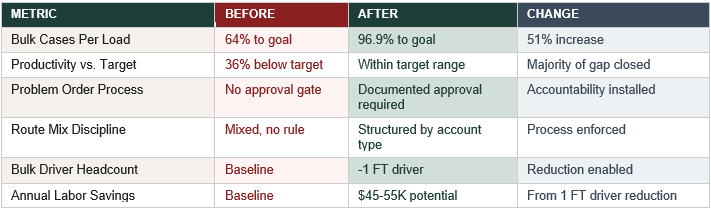
A GTM bulk delivery operation was running bulk deliveries at 64% to their cases per load goal . The gap was not new, it had been a persistent miss and was holding the market back from its broader delivery goals. Bulk delivery productivity drives route efficiency directly: more cases per load means fewer routes to cover the same volume, which means fewer labor hours. At their average cases per load, the team was leaving that efficiency on the table every period.
Three problems were driving the gap but nobody had mapped them formally or prioritized them by effort and impact:
Routes were being run with the wrong truck types
Problem orders were moving through without any approval gate
Customer time windows were creating scheduling friction the routing team was absorbing without escalation.
The operation had workarounds for all of it and none of them were fixing anything.
The Action
A Lean Six Sigma event was led to identify root causes and build solutions that would hold. The process was mapped end to end. The top pain points were identified through structured multi-voting: mixed truck types on bulk routes, customer time window constraints, off-schedule orders and orders placed under the delivery minimum.
Each was taken through a 5 Why analysis to find the root cause rather than the presenting symptom. A Benefit/Effort Matrix sequenced the solutions into immediate actions and longer-term fixes.
For orders under minimum and off-schedule orders, an approval flow was built and implemented immediately. Before this, those orders moved through the system without any gate, creating route inefficiency nobody was accountable for. The new process required documented approval before a problem order could be placed.
For the mixed truck route problem, routes had been running with small-format (convenience store size) accounts on straight-trailer bulk trucks and large-format accounts (big box store size) on side-loaded bay trucks, producing undersized loads on both. The fix was a clean process rule: small-format accounts stay on bay routes, large-format accounts stay on bulk routes. The rule was piloted on the next delivery date and results were recorded immediately so adjustments could be made before the next cycle.
A Solution Compliance Scorecard tracked adherence through the following two periods to confirm the gains held without requiring ongoing oversight to maintain them.
The Result
Bulk delivery productivity increased by 51% from the baseline. The gain moved the GTM team from well below target into a range where the operation could meet its period productivity goals. The work was flagged for replication in a second market and contributed to $40M in regional savings.